This is a web to print edition of Vernacular Web 2 by Olia Lialina
click on the gifs and see some surprises,
take some beautiful paper and print it at home <3
I recommend you to print with your computer, but you can read on your phone by clicking on the toggle single view !
In the beginning this article was an “index.html” saved in the “glitter” folder. Then it got the working title “The work of users in times of perfect templates”. Then it became “Rich User Experience for the Poor” and was presented at the New Network Theory conference. After the presentation, UCSB professor Alan Lui suggested to rename it to “Homesick”. But for the moment I'll leave it as
Vernacular Web
2
Two years ago I wrote an article titled “A Vernacular Web”, in which I tried to collect, classify and describe the most important elements of the early Web – visual as well as acoustic – and the habits of first Web users, their ideas of harmony and order.
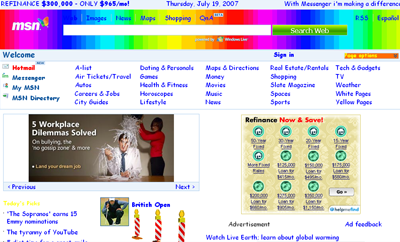
I’m talking about everything that became a subject of mockery by the end of the last century when professional designers arrived, everything that fell out of use and turns up every now and again as the elements of “retro” look in site design or in the works of artists exploring the theme of “digital folklore”: the “Under Construction” signs, outer space backgrounds, MIDI-files, collections of animated web graphics and so on.
If you are missing the way pages looked before, you should install The Timemachine Firefox Add-on by Tobias Leingruber.
And today, in the end of June 2007, when we hear of amateur culture more often than ever before, the cultural influence of “Welcome to My Home Page” web pages looks especially interesting. People who created them and their ideas of what the Web is, how it can be used and how the pages should look, these people’s likes and mistakes gave the today’s Web its current shape.
To me, what defines the history of Web is not just the launch dates of new browsers or services, not just the dot-com bubbles appearing or bursting, but also the appearance of a blinking yellow button that said “New!” or the sudden mass extinction of starry wallpapers. Jenkins wrote in his 2002 article Blog This!:
“We learned in the history books about Samuel Morse's invention of the telegraph, but not about the thousands of operators who shaped the circulation of message.”
To rephrase him, I’d say we’ve studied the history of hypertext, but not the history of Metallica fan web rings or web rings in general.
The relationship between ordinary users and the Web of the 90s is a very interesting subject to study, because it’s a relationship filled with love, hate, all kinds of drama – in other words, it’s a full-blown relationship between a new medium and its first users, a relationship that’s exalted, complex, sometimes silly – whatever it is, all that matters is that it existed.
Today, that relationship is gone. And for a good reason. The space that we’ve researched as a new medium for the last ten years has turned into the most mass medium of them all. Nothing more than a mass medium, permeating our daily lives to the point of becoming invisible. Its numerous users are busy working, having a good time or expressing themselves, and they have almost perfect tools and services at their disposal. Connection never breaks, distinction between a server and a hard disk, between your desktop and that of another person has almost vanished, and there’s nothing that could contribute to the development of user-media relationship, nothing to provoke us.
Web 2.0 propagandists can’t stop talking about the multitude and power of today’s web amateurs, the new users who love to dance, compose songs, write encyclopedic articles, take photos and film videos, write texts and publish it all on the Web. And yet, they are rather indifferent to the Web itself.
So, here’s the question: how does the Web look now, when it’s no longer seen as the technology of the future, when it’s intertwined with our daily lives and filled by people who are not excited by the mere fact of its existence?
At a first glance, this question looks like a purely aesthetic one. One might think it’s almost unimportant. But in fact, nothing demonstrates the state of the Web in general and the state of its services, in particular the ones that follow the Web 2.0 ideology, as clearly as the style and look of ordinary users’ home pages.
I’ll skip several big subjects:
Unfinished research on the topic of cats in today’s Web. They are becoming so important that in the nearest future conferences binded with Internet subjects will have to announce LOLCats
or Kitten of the Day panels to discuss things that really matter.
Animated cursors, a phenomenon equally ridiculous and dangerous.
Relations, Marriage, Pregnancy, Breastfeeding, Child age calendars, as an ultimate form of life visualization in online communities and diaries.
These and other topics need further exploration and time I wasted staring at Glitter Graphics.
 If you ever talked about the Web with me – or talked with me at all – you probably know that my favorite thing in the world are animated GIF files and starry sky wallpapers, preferably animated as well. I just like the way they look, and I like them as a reminder of fun times when the users made a travesty out of the worldwide digital network.
The online life of a today’s user is full of diverse attractions, and yet it follows very strict standards. It is disciplined and fomalized. There is a particular service offered for every format a user may want to share with the world, a community for every interest, a network for every social group. And mash ups for artists, and SL for 3d and furries. And there is something for animated GIF makers, too – there are glitter graphics generators and collections of ready-made graphics.
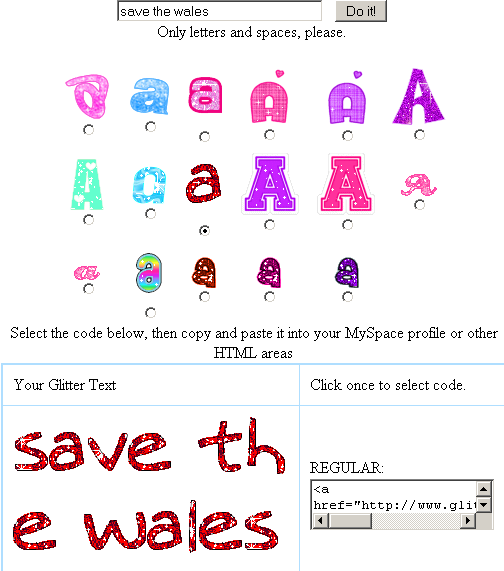
Generators such as this one allow you to enter as much text as you want and make it glittery. You get to choose from the unbelievable array of sparkling things. Such collections offer glittery graphics for every occasion – whether you need to say hello or goodbye, to thank someone, wish a good day or just to sparkle and let your cursor and userpic sparkle with you.
I think there are two important aspects to the glitter graphic phenomenon.
Firstly, glitter became a trademark of today’s amateur aesthetics, and I’m certain that in the future sparkly graphics will become a symbol of our times, like “Under Construction” signs for the 90’s. Glitter is everywhere (in the universe of user-generated pages), it has become a meta category. It has absorbed all other categories of ready-made graphics – people, animals, buttons, sex graphics. I missed the moment when glitter graphics were born, and didn’t notice it until two years ago, when I stumbled upon glittertextgenerator.net. Since then, new sites have appeared:
It seems like every word with “Glitter” in front of it is now a site name.

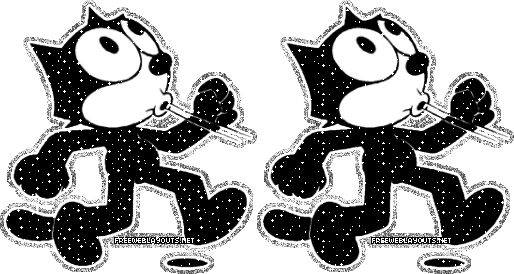
Secondly, I can’t stop marveling at how similar to each other and dull they are. Even naked gals from the “Glitter/Erotic” category don’t move – they just sparkle, even my favorite hero Felix, the never-stopping Felix, is frozen in mid-air.
➜ View complete comparative gallery
This is the animation trend for the times when templates and generators rule the Web. Let’s call it Rich User Experience for the poor. But the reason for it’s popularity is not just because it’s easy to generate.
The social networks researcher Danah Boyd from Berkeley University notices “flashy look of MySpace resembles the Las Vegas imagery that attracts millions every year.”
➜ See the 2007-08-21 addition at the bottom of the page
My daughter, who is almost fourteen, thinks that glittery graphics is the same thing as glittery stickers (only digital). Among pre-teens, glittery stickers are considered the most valuable objects. You can get several non-glittery things for one that glitters.
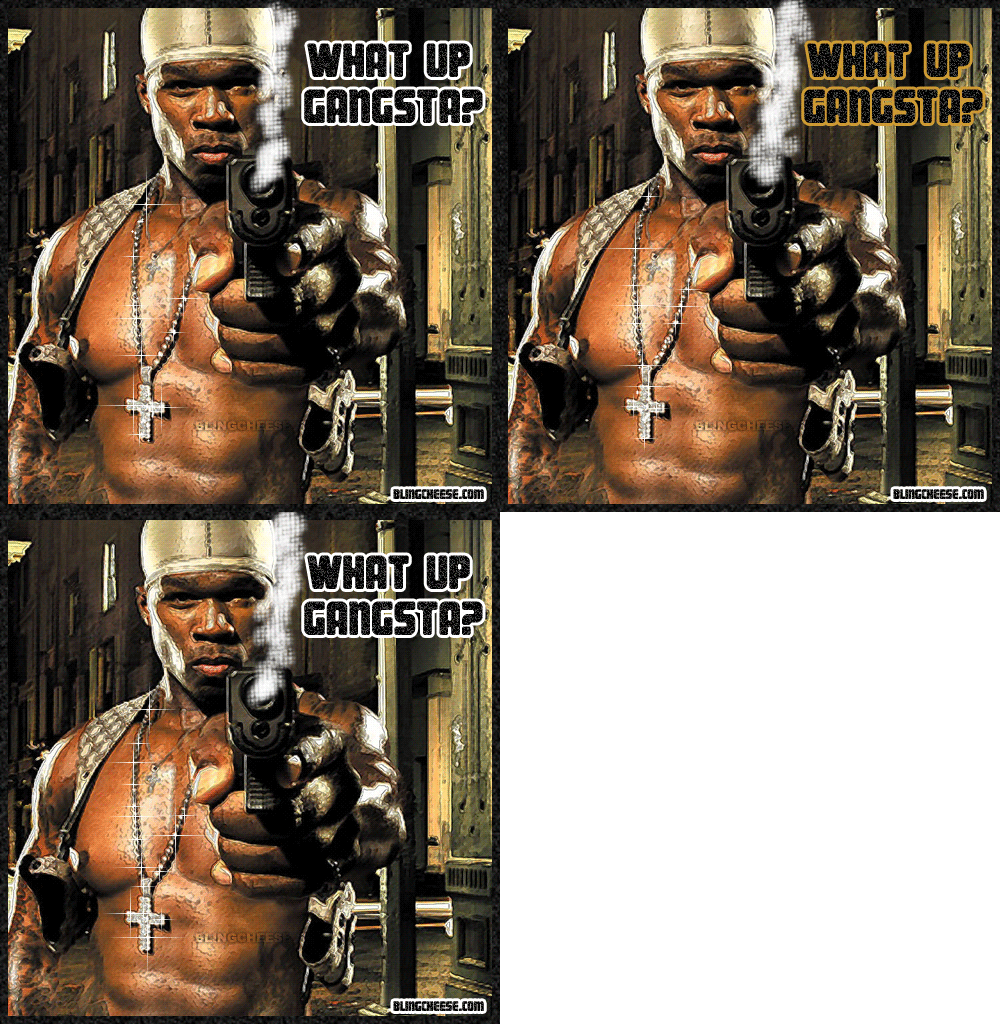
My almost former student Dennis Knopf, a big expert in the online booty and move that thing segment, sees a direct link between glittery graphics and the pimp pop culture, which before MySpace we knew mainly from hip-hop videos.
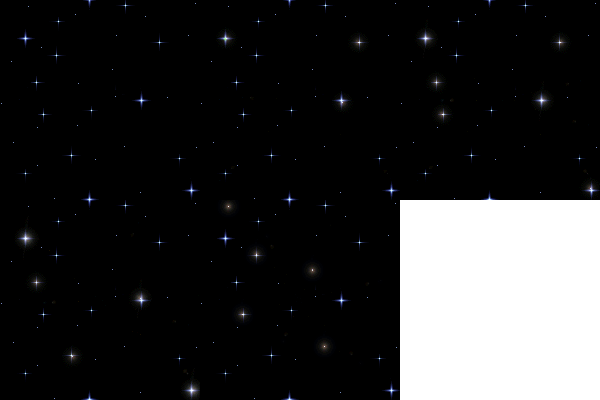
I agree with both of them, and there’s something I’d like to note in the end. If we take glitter and starry backgrounds out of context, they will look almost the same – the particles of flickering light on a darker background. But there’s a huge gap between these two. Starry backgrounds represented the future, a touching relationship with the medium of tomorrow. Glitter decorates the web of today, routine and taken-for-granted.

additions
2007-08-21
In June 2007 Danah Boyd reviewed American class divisions through Facebook and MySpace.
Her observation is that good kids go to Facebook, bad kids go to Myspace, and that “MySpace and Facebook are new representations of the class divide in American youth.”
Boyd writes about the aesthetics appearances of both services:
These teens [who exclusively use Facebook] are very aware of MySpace and they often have a negative opinion about it. They see it as gaudy, immature, and “so middle school.” They prefer the “clean” look of Facebook, noting that it is more mature and that MySpace is “so lame.” What hegemonic teens call gaudy can also be labeled as “glitzy” or “bling” or “fly” (or what my generation would call “phat”) by subaltern teens. Terms like “bling” come out of hip-hop culture where showy, sparkly, brash visual displays are acceptable and valued. The look and feel of MySpace resonates far better with subaltern communities than it does with the upwardly mobile hegemonic teens. This is even clear in the blogosphere where people talk about how gauche MySpace is while commending Facebook on its aesthetics. I’m sure that a visual analyst would be able to explain how classed aesthetics are, but aesthetics are more than simply the “eye of the beholder” – they are culturally narrated and replicated. That “clean” or “modern” look of Facebook is akin to West Elm or Pottery Barn or any poshy Scandinavian design house (that I admit I'm drawn to) while the more flashy look of MySpace resembles the Las Vegas imagery that attracts millions every year. I suspect that lifestyles have aesthetic values and that these are being reproduced on MySpace and Facebook.
Boyd’s observation is very right. The “clean” pages of Facebook stay for design, professionalism, security, better service and upper class. (I cannot call Facebook clean without the quotation marks. The use of light colors and small fonts can’t hide the structural clumsiness.)
However, very soon Boyd’s argument will expire.
On the 18th of August blingee.com, a service for glittering profile graphics, already owning the hearts of all “glitzy” users, announced:
Facebook users can now join the Blingee fever. Send your Blingees to your Facebook profile, and get your friends to browse and rate your Blingees directly from your Facebook profile!
Facebook, in its turn, put it even clearer:
Express yourself, create a Blingee! Add animated graphics, comments, and all sorts of goodies to your pictures for fun or glamour.
Facebook joined the getto glitter fever. Not without keeping its face, so it is not just Blingee, but an option to make a Blingee Book in your profile. I’ve already created one and now wait for my friends to see and rate it:
I guess Blingee is a good move towards Facebook’s myspacisation. They will soon incorporate funny cursors, lake applets, background sound and the rest of the vernacular repertoire.

I can be wrong. Maybe right at this moment conscious upper class users are caning the Facebook admins with angry demands to remove this inappropriate application from their “clean” pages. But then, I don’t know how are they going to spend their time on this service. As a communication platform Facebook is mega boring. Since it’s impossible to create there profiles like this, there is hardly a reason to give them your data.



Olia Lialina was born in Moscow. She is a Net Artist, one of net.art pioneers, animated GIF model. She is co-founder of Geocities Research Institute and keeper of One Terabyte of Kilobyte Age Archive. She writes on New Media, Digital Folklore, Vernacular Web and Human Computer Interaction.
You can look at her previous publications :